Our group arrived in Armenia from Georgia via the Bagratashen–Sadakhlo border crossing. The capital city of Yerevan, our final destination, lay about 125 miles away.
I’d spent the previous ten days in Georgia, whose language is truly unique — after all that time, I still couldn’t manage “good morning.” Armenia’s alphabet was just as unfamiliar to the eye, but the syllables landed differently on the ear. Armenian is an independent branch of the Indo-European language family, and something in it felt oddly familiar after ten days of Georgian bouncing off my brain.
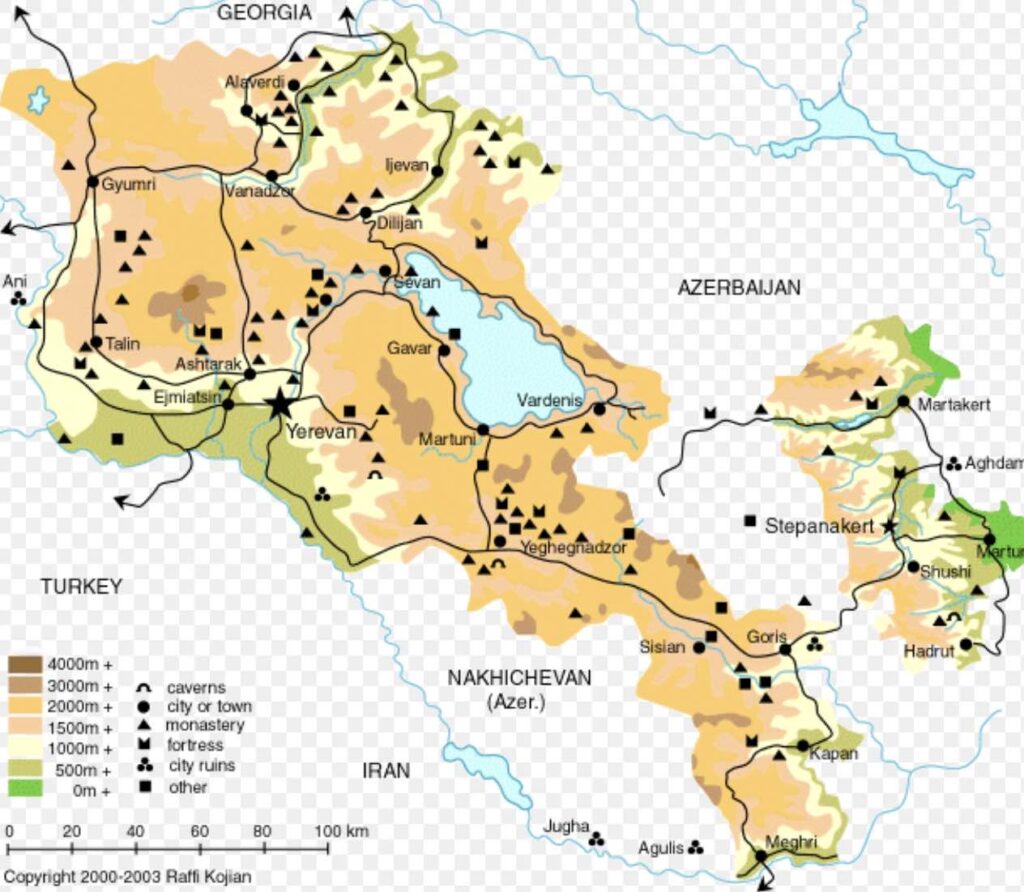
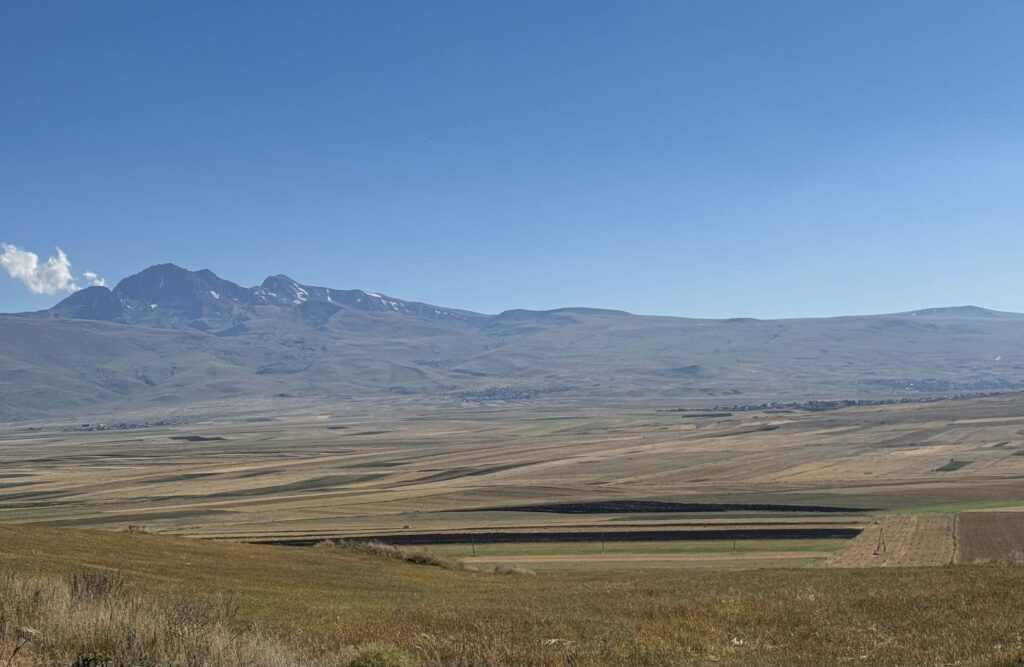
Armenia is roughly the size of Maryland, with rugged terrain and an average elevation of 5,900 feet. The Lesser Caucasus range cuts through the north and east, the land buckled and cracked into steep-sided mountain blocks, deep gorges, and dramatic volcanic cones. Our route wound alongside a plunging river gorge, and we paused briefly to take in the view of Mount Aragats — the highest point in the country, at 13,418 feet.
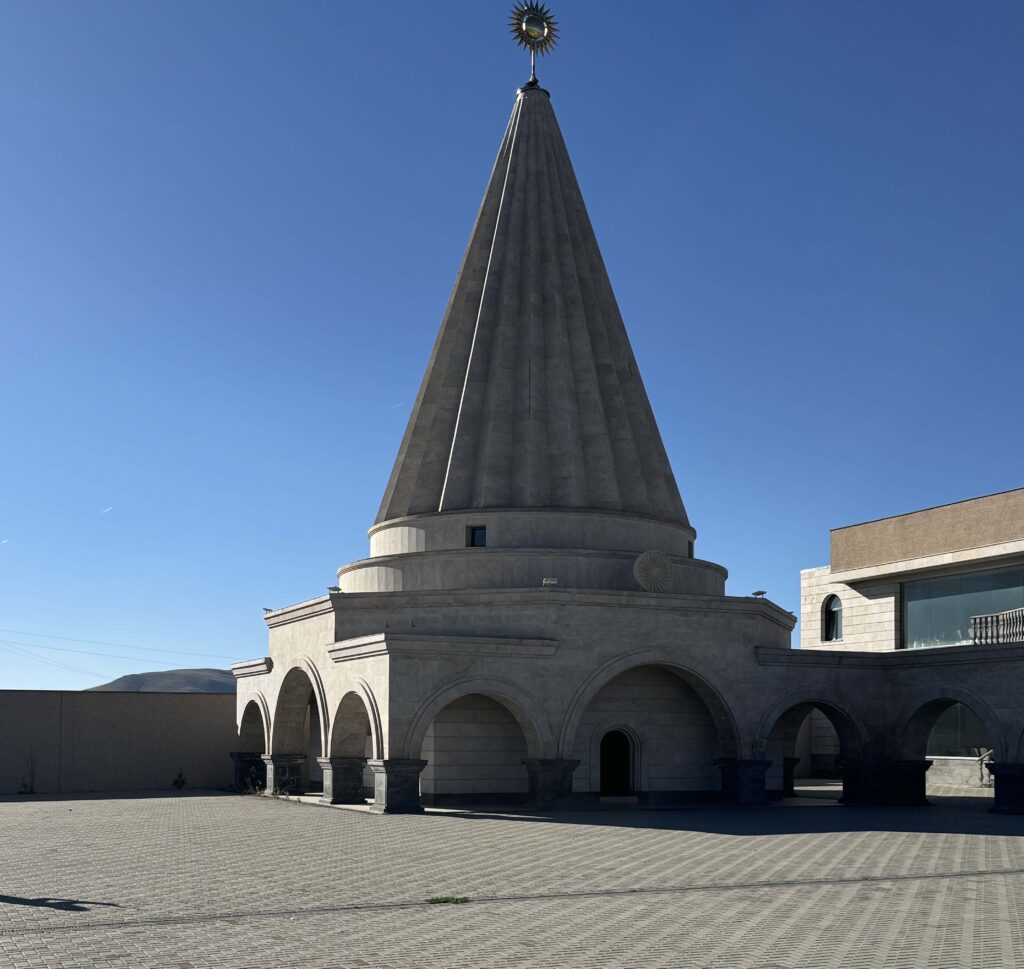
The road drifted away from the gorge, and the landscape opened up into wind-blown steppes, suited to sheep herding and light agriculture — the kind of terrain that had drawn Yezidi settlers here since the 1800s. We visited their temple in the village of Rya Taza. This distinct ethno-religious minority follows an ancient, monotheistic religion centered on a supreme God and the Peacock Angel. Members must marry within the faith — within their exact spiritual caste. Historically, young women entered arranged marriages as soon as they reached puberty. In Armenia, the community has agreed to adhere to national laws requiring girls to attend school and prohibiting marriage under the age of 18.
It was only an hour’s drive from that rural, pastoral village to the bustle and noise of Yerevan, a sprawling metropolis of nearly 1.1 million people — roughly 35% of the country’s total population. The outer ring of the city features striking, futuristic high-rises, many of them being snapped up by diaspora Armenians, affluent Russians, buyers from the Gulf states like Saudi Arabia, and high-ranking politicians.
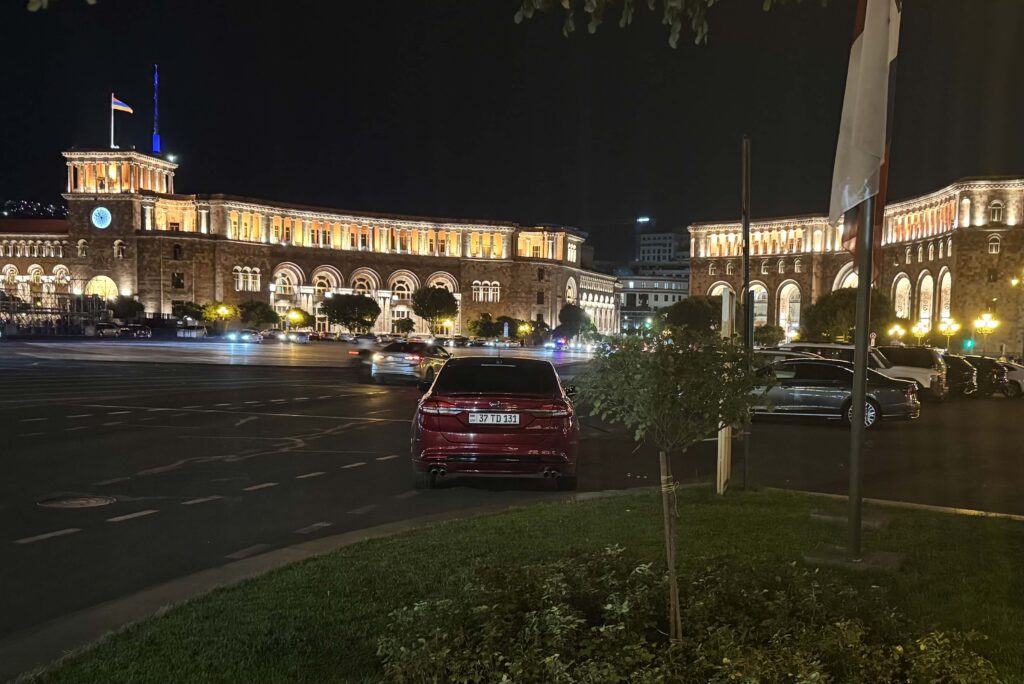
Known as the “Pink City” for its widespread use of tuff — a local, pink-hued volcanic rock — Yerevan is a master-planned capital. Our hotel, the Marriott, sat right on Republic Square. By day, the massive Soviet-style buildings and the wide concrete roundabout felt oppressive rather than grand, hemmed in by a gray haze that hung over the city — Yerevan sits in a natural, bowl-like valley that traps pollutants beneath stagnant air, worsened by construction, nearby stone quarries, and traffic from older vehicles. At night, though, the area transforms: darkness softens the harsh edges, and warm accent lighting picks out the curves of the arched windows and stone soffits.
One of the grand showcases of the Soviet era in the city is The Cascade, a monumental limestone stairway full of hidden symbolism — the count of its steps, for instance, is said to reference the founding year of Armenia. It looked like a building commissar’s idea of the future. The original architect was strikingly unconcerned with safety: there isn’t a single handrail along the external 572 granite steps. I also found it profoundly ironic that from the very top of this complex, you get an unobstructed view of Mount Ararat — Armenia’s ultimate national and cultural symbol, which now sits just across the border in the territory of its historic rival, Turkey.
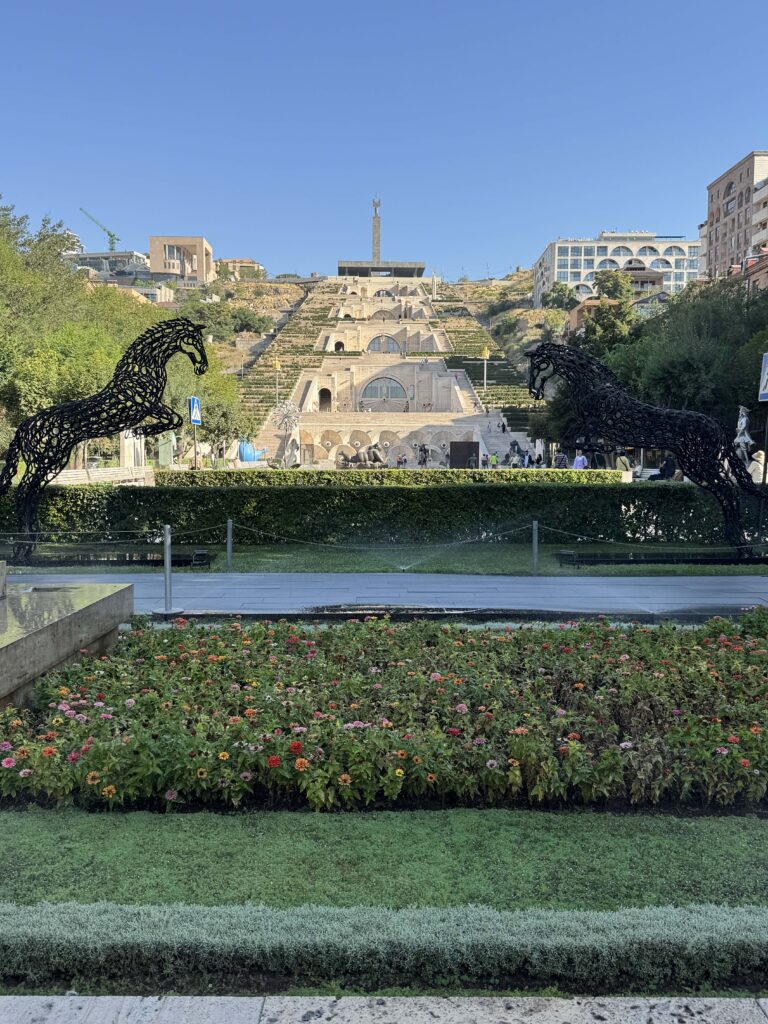
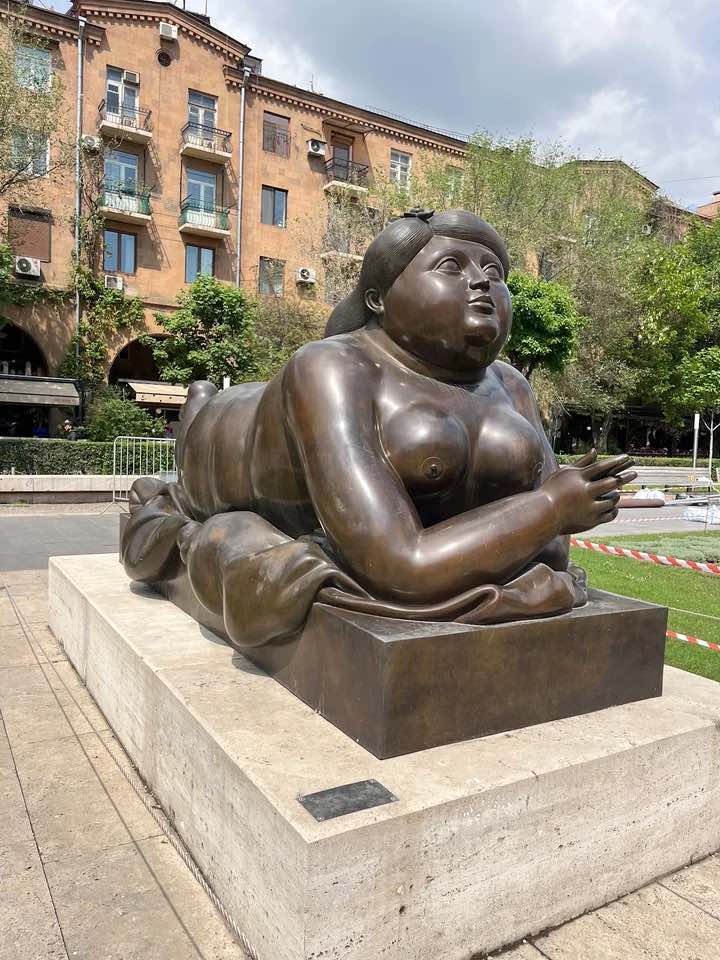
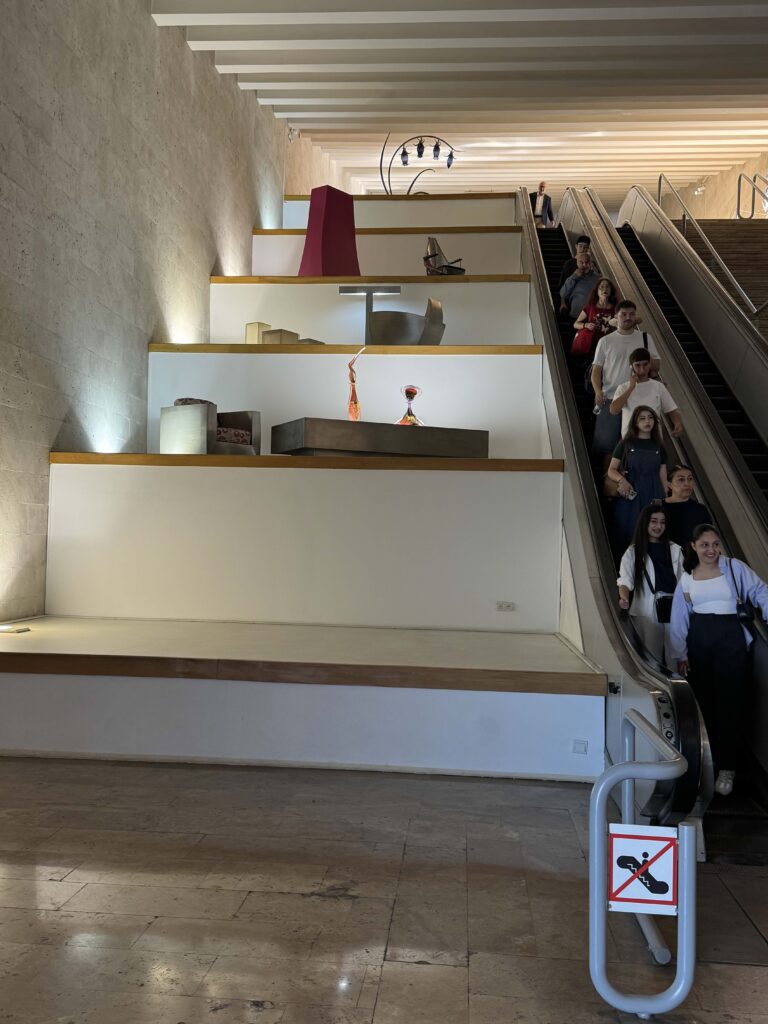
The artwork throughout the site is intriguing, particularly the outdoor Cafesjian Sculpture Garden, which features world-renowned modern pieces like the bronze cat and Roman warrior by Colombian artist Fernando Botero. His sculpture, Smoking Woman, is the title image for this post. Inside the complex, though, the galleries are disappointing — the loud, grinding escalators echo off the concrete walls and disrupt the viewing experience.
Despite my distaste for harsh Soviet-era architecture, the city itself is incredibly walkable. Northern Avenue, the main pedestrian thoroughfare running from the Opera House to Republic Square, is delightful day and night — though it also has the polished, cookie-cutter feel of a European city center, glass storefronts and international brands, a world away from the temple in Rya Taza. The area is safe, the local wine is inexpensive, and the food is tasty.
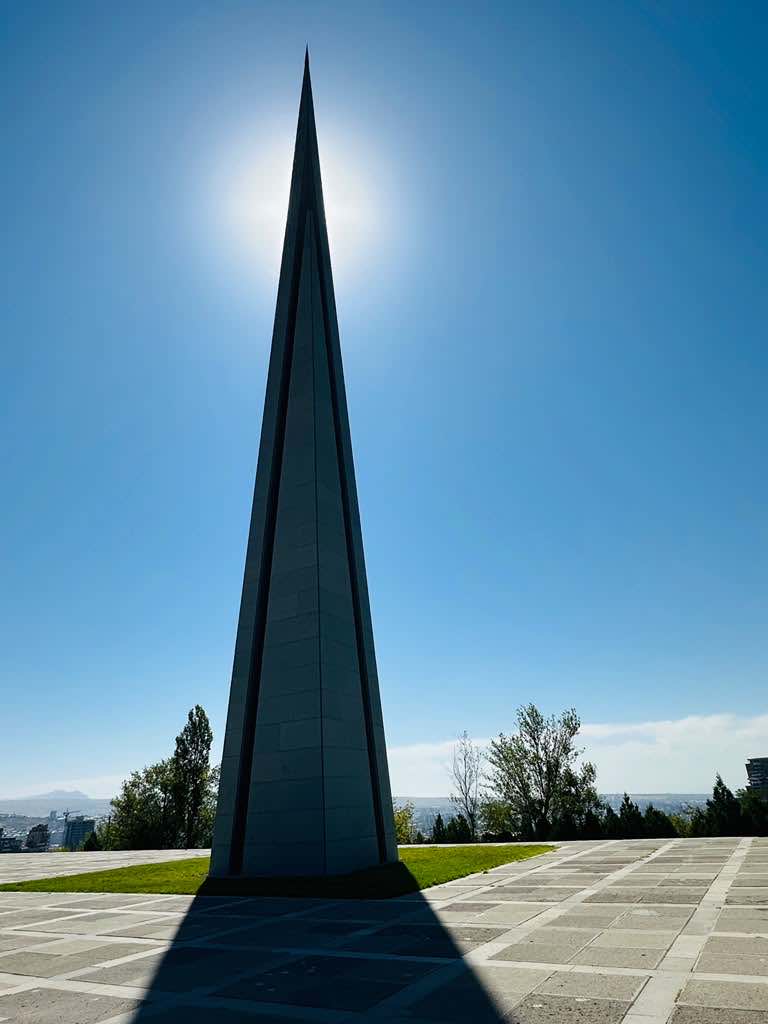
Perched on a hill overlooking the city center is the Armenian Genocide Memorial Complex (Tsitsernakaberd). The site — an underground museum, a 44-meter concrete stele, and a quiet pine forest — draws over 100,000 visitors annually. Construction began in 1965, during the Soviet era, after massive public demonstrations. To this day, Turkey officially denies that a genocide took place. In the surrounding forest, a new tree is planted each time a foreign government formally recognizes the tragedy; the United States did not do so until 2021, after decades of deference to Turkey as a critical NATO ally in the Middle East.
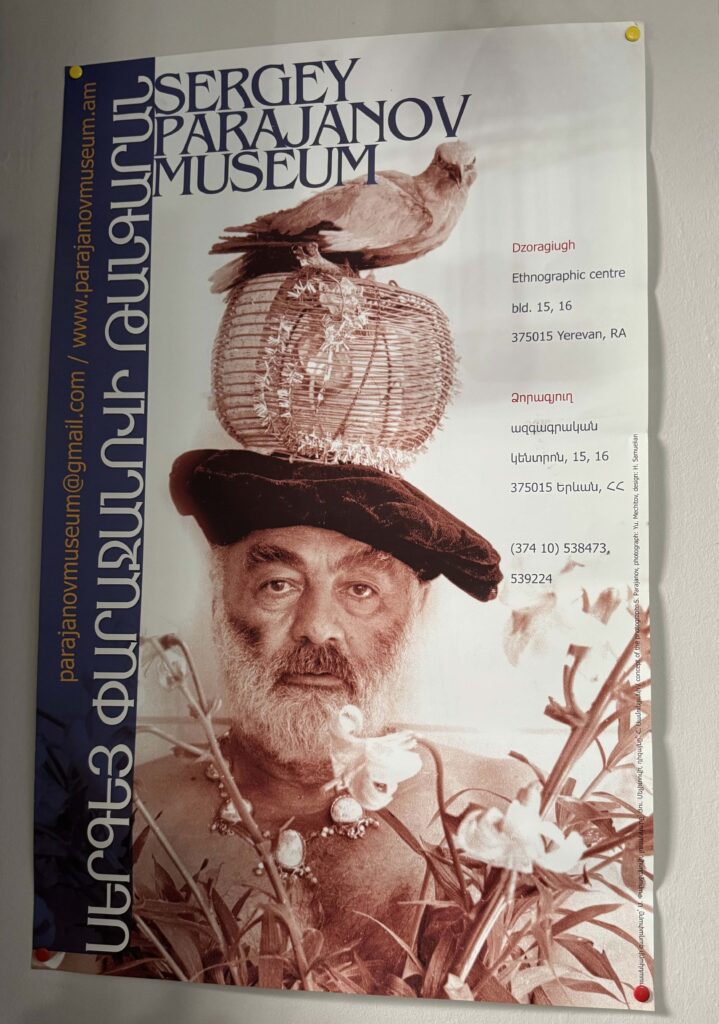
As a lighter counterweight to the solemnity of the memorial, our afternoon took a whimsical turn with a visit to the Sergei Parajanov Museum. Parajanov was a visionary Soviet-Armenian film director and artist whose avant-garde masterpieces, like The Color of Pomegranates, ran afoul of Soviet censors and led to his imprisonment. The museum is a testament to his genius, packed with eccentric, brilliant collages, dolls, and assemblages made from scraps of fabric and found objects.
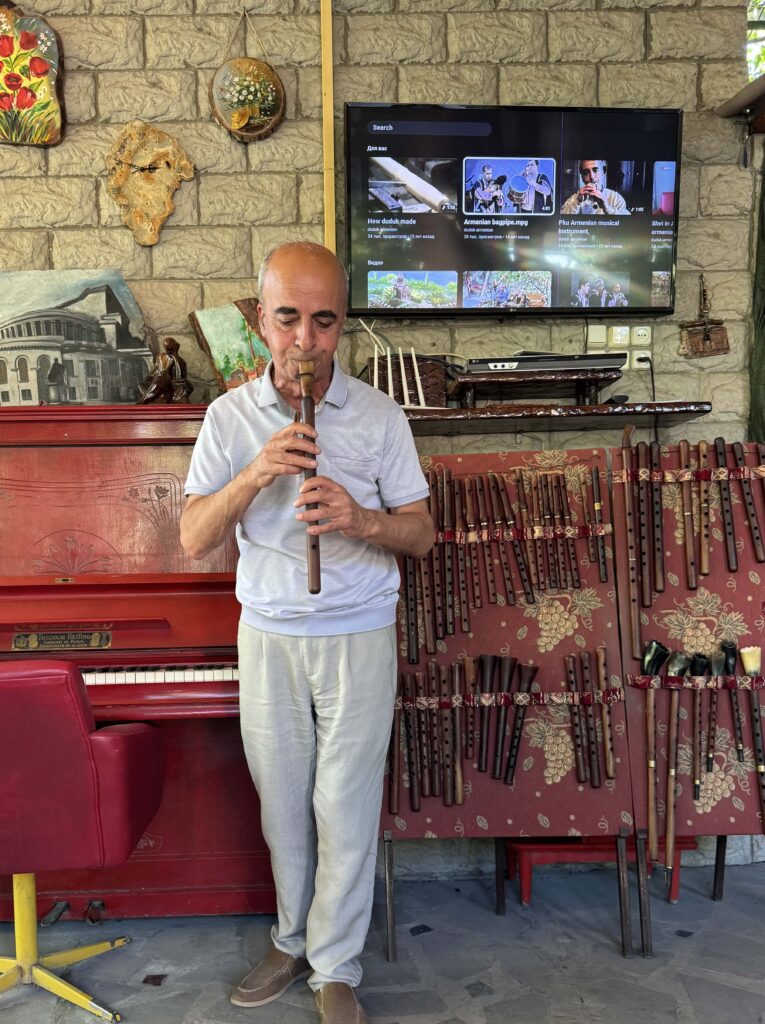
We closed the day with a deep dive into one of Armenia’s most beloved traditional instruments: the duduk. Our host, an accomplished musician, treated us to several folk pieces. The instrument is carved from aged apricot wood, and its double-reed design produces a rich, velvety sound with a beautiful undercurrent of melancholy. The setting was a backyard oasis hidden behind and beneath the city’s construction and redevelopment.
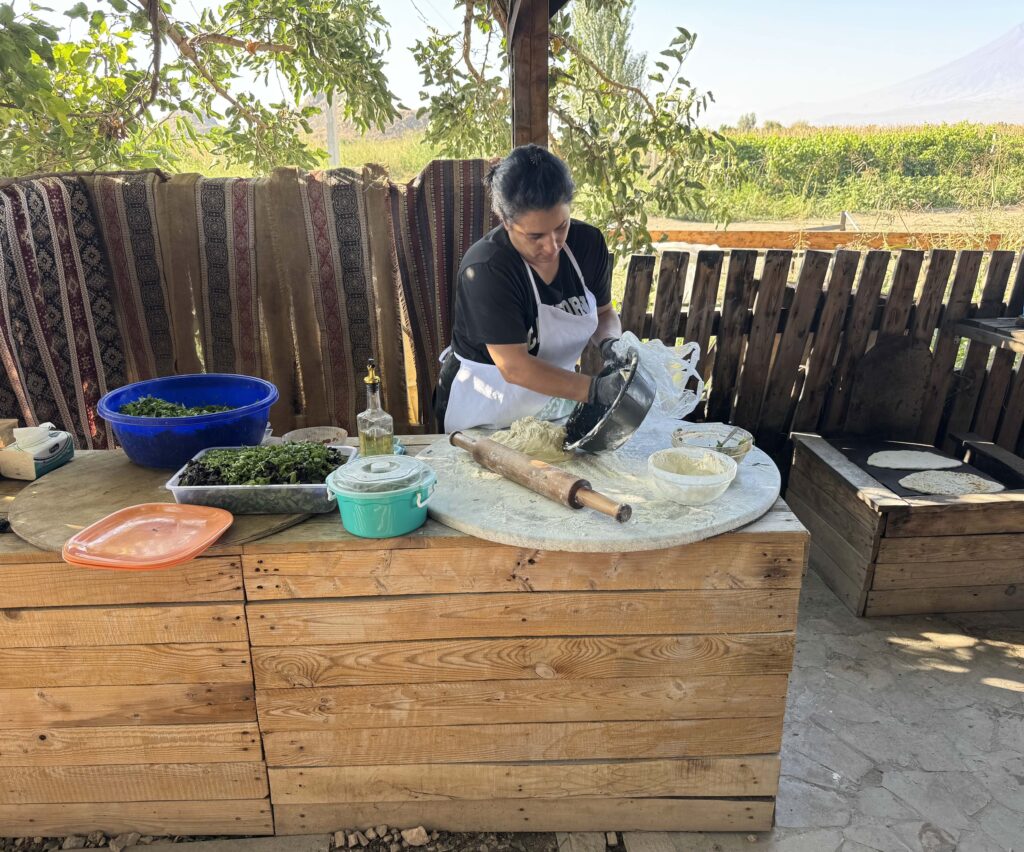
The next morning, we headed south toward Khor Virap Monastery, which sits right against the heavily fortified Turkish border. En route, we stopped at a small roadside stand run by ethnic Armenians displaced during the 2023 Nagorno-Karabakh war. More than 100,000 ethnic Armenians were forced to flee their ancestral homes during that conflict with Azerbaijan, after which Azerbaijan took total control of the region.
Khor Virap Monastery sits atop a small knoll, reached by a short walk on uneven ground. That wasn’t unusual — plenty of sites on this trip came with some physical challenge: uneven steps, cobblestone walkways, dimly lit stone interiors, or long walks in the heat. I was lucky to be traveling with a great group; no one groused, and everyone was cooperative, curious, and pleasant. The senior member of our group, Bill, is 86 years old, and I want to mention him specifically — he was still scampering up hills, exploring ancient sites, and sharing his knowledge alongside his lovely wife Louise. He’s my inspiration. I hope I’m still traveling at 86; more than that, I hope I’m as gracious as Bill and Louise. Now, back to the trip.
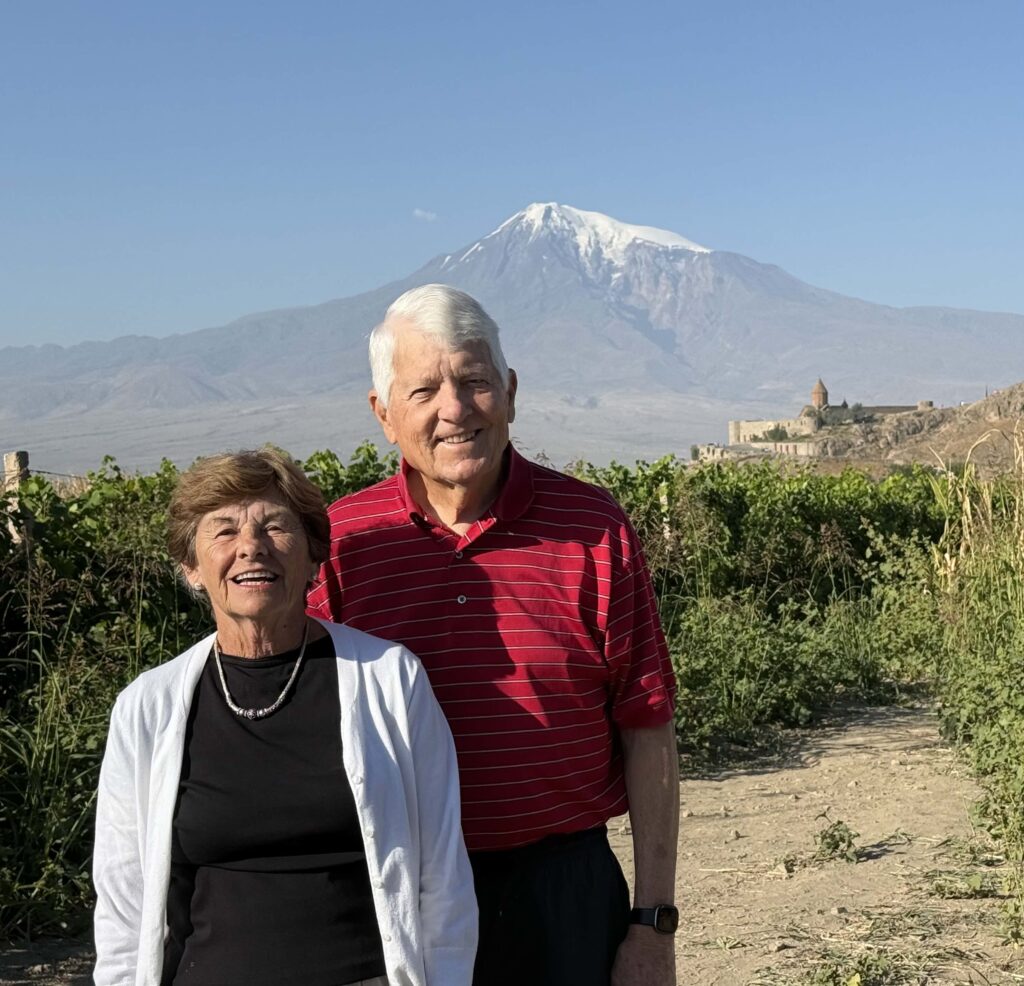
The small chapel at Khor Virap, built in AD 642, stands directly over the underground pit where Saint Gregory the Illuminator was imprisoned. He survived thirteen years in a dark, snake-infested hole before being called on to heal the king. According to tradition, King Tiridates fell severely ill and was driven mad; his sister, Khosrovidukht, dreamed that only the imprisoned Gregory could cure him. Gregory was pulled from the pit, prayed over the king, and miraculously healed him. Grateful, the king embraced the Christian faith, and in 301 AD Tiridates declared it Armenia’s official state religion — making Armenia the first nation on earth to adopt Christianity as state religion.
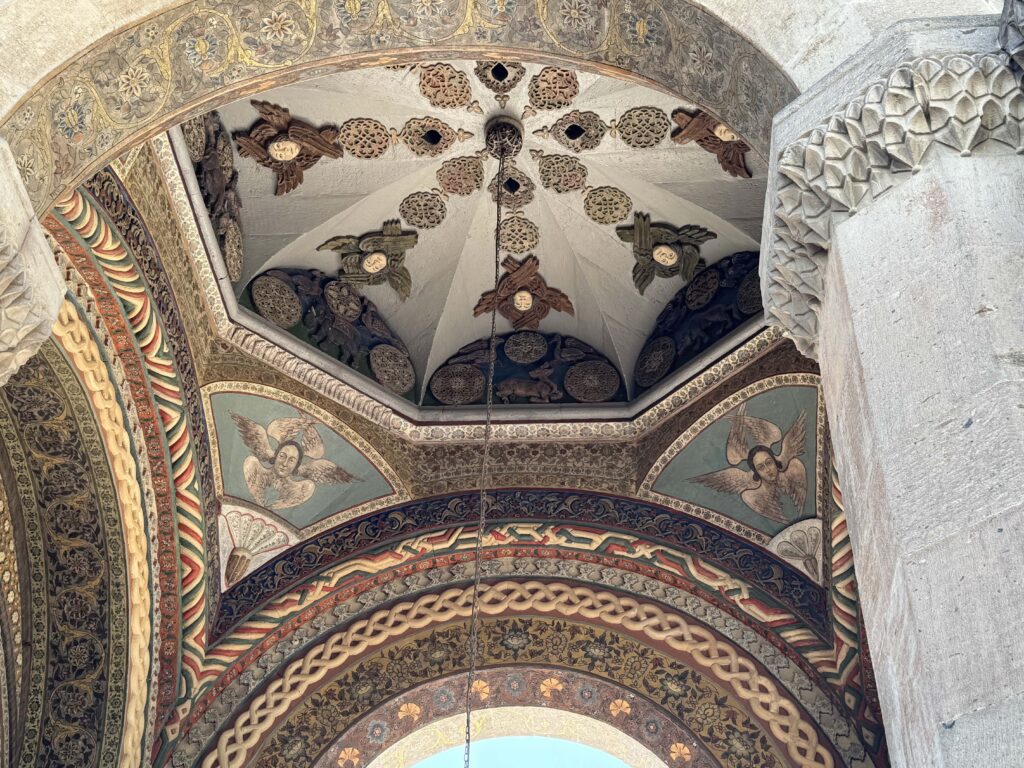
The day, it turned out, had a theme: religion. In keeping with it, our next stop was Etchmiadzin Mother Cathedral, considered the oldest cathedral in the world. Originally completed in AD 303 and expanded across the centuries, its interior is unusual for an Armenian church — the color palette and intricate floral motifs, painted in the 1720s by the legendary court artist Naghash Hovnatan, reflect a strong Persian influence.
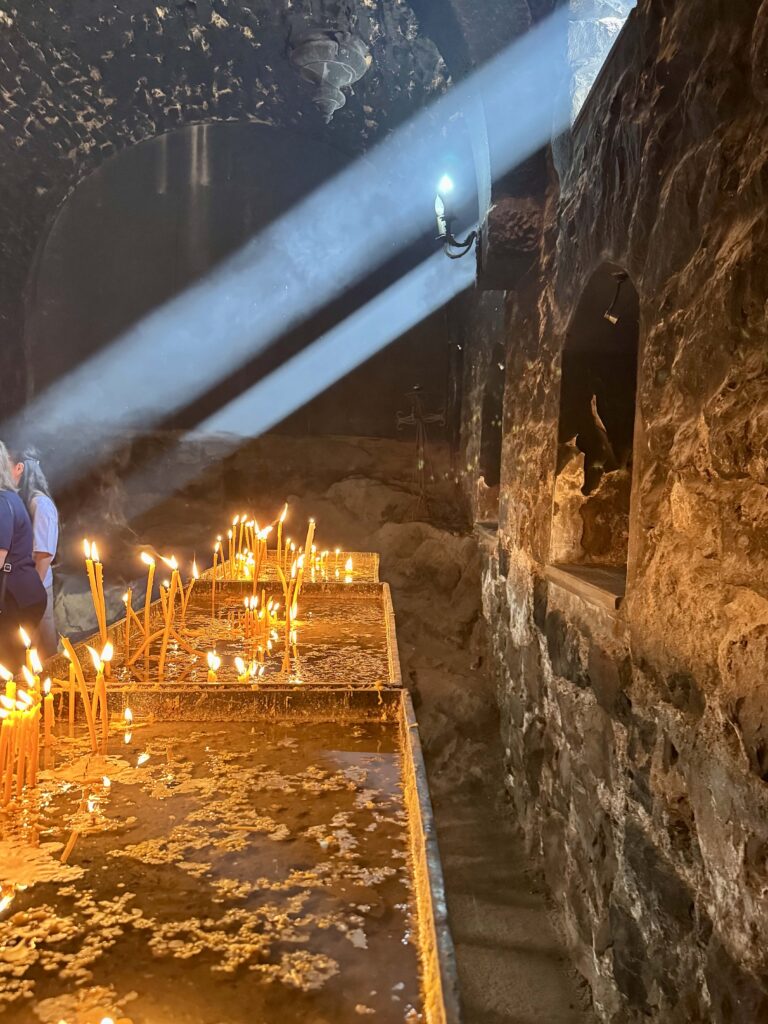
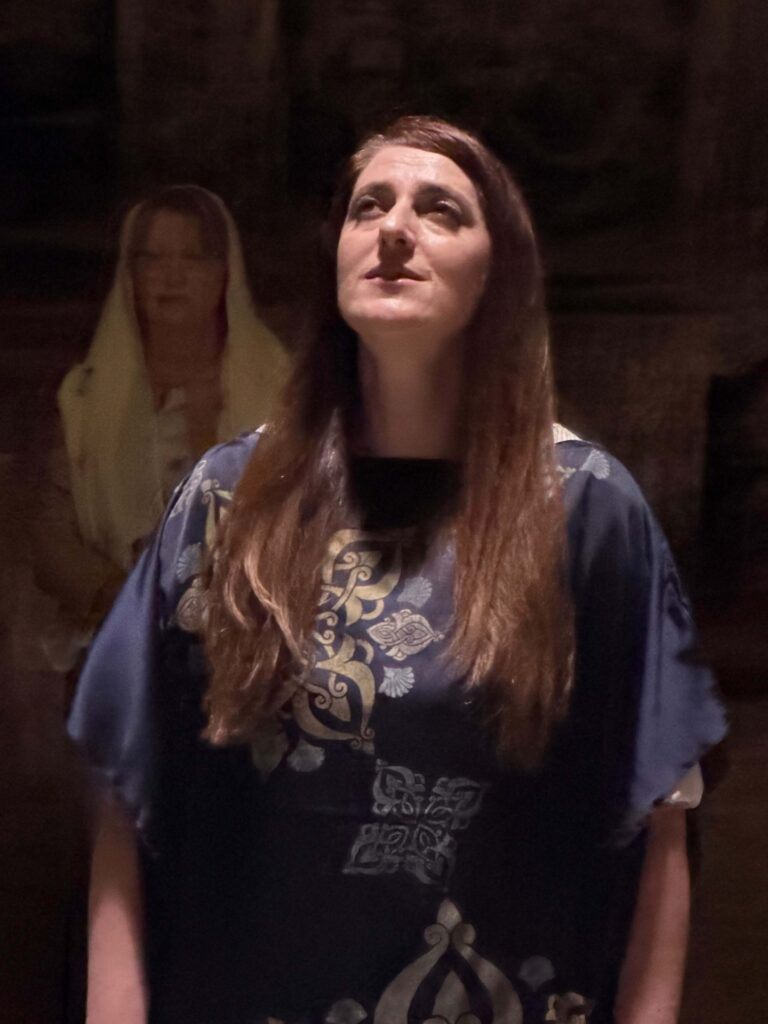
On our final full day in Armenia, we headed west to reach Geghard, a monastery built directly into the cliff face, before the midday crowds arrived. It was Sunday, and a few devout locals were already lighting beeswax candles in the shadows of the main chapel. After exploring, our guide led us to the upper rock-carved chamber, where we were treated to some of the most beautiful, inspired music I’ve ever experienced. A female quintet stood at the center, singing medieval hymns. The ancient stone had been hand-hewn to scatter and hold sound rather than let it simply echo, and the effect was extraordinary — five voices blurred into one another until they sounded like a single, vast chorus. Their voices filled the domed chamber before rising straight toward the heavens.
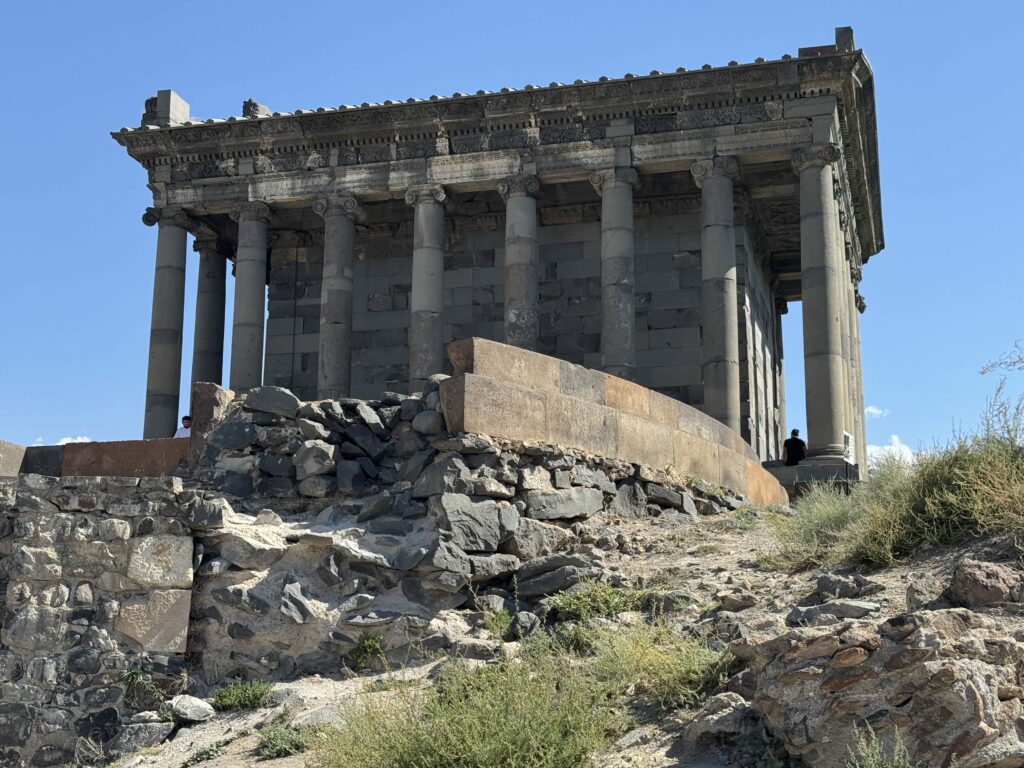
Our final official stop on the OAT tour was the meticulously restored Garni Temple, a 1st-century Hellenistic structure perched on the edge of a triangular cliff, overlooking the Garni Gorge and the Azat River.
The trip back to Yerevan did not go to plan. It was Sunday, the final day of the inaugural Tour d’Arménie, a multistage cycling race covering 587 km with 5,300 m of elevation gain. Our bus driver dropped us about a kilometer from our hotel — the race’s finish line ran directly in front of the Marriott, and we couldn’t cross the course.
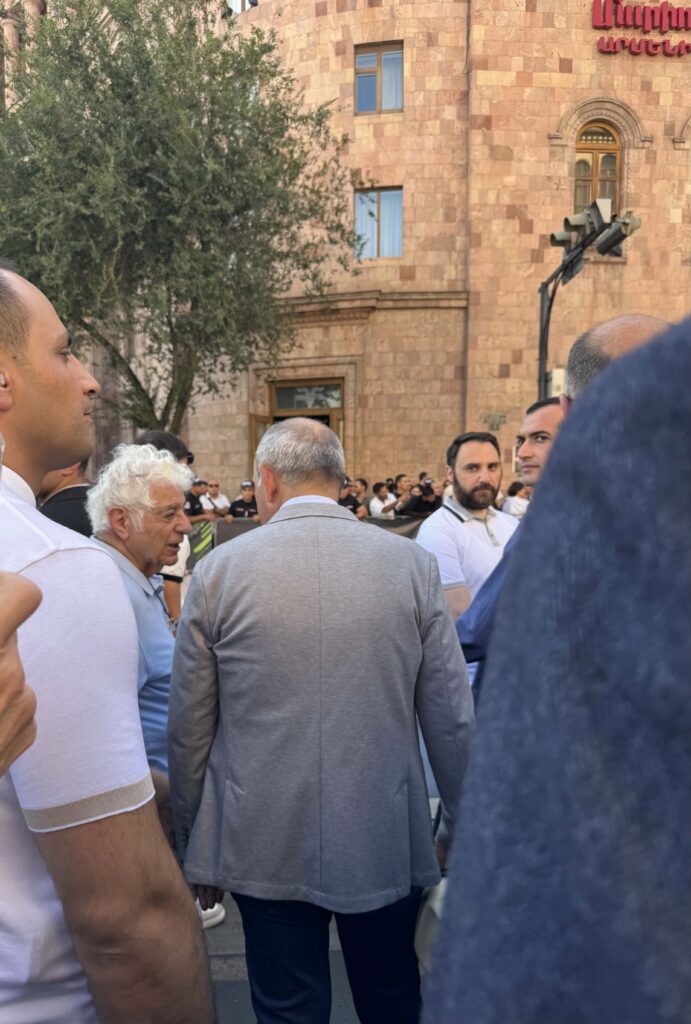
We stood with a crowd of spectators watching the racers come in. Suddenly I found myself being jostled and pushed by large men in dark blue blazers with earpieces. Caught off guard by the sudden jostling, and slightly annoyed, I soon learned why: the president of Armenia had arrived. I was standing ten feet from Vahagn Khachaturyan — close enough to get a picture of his bald spot.
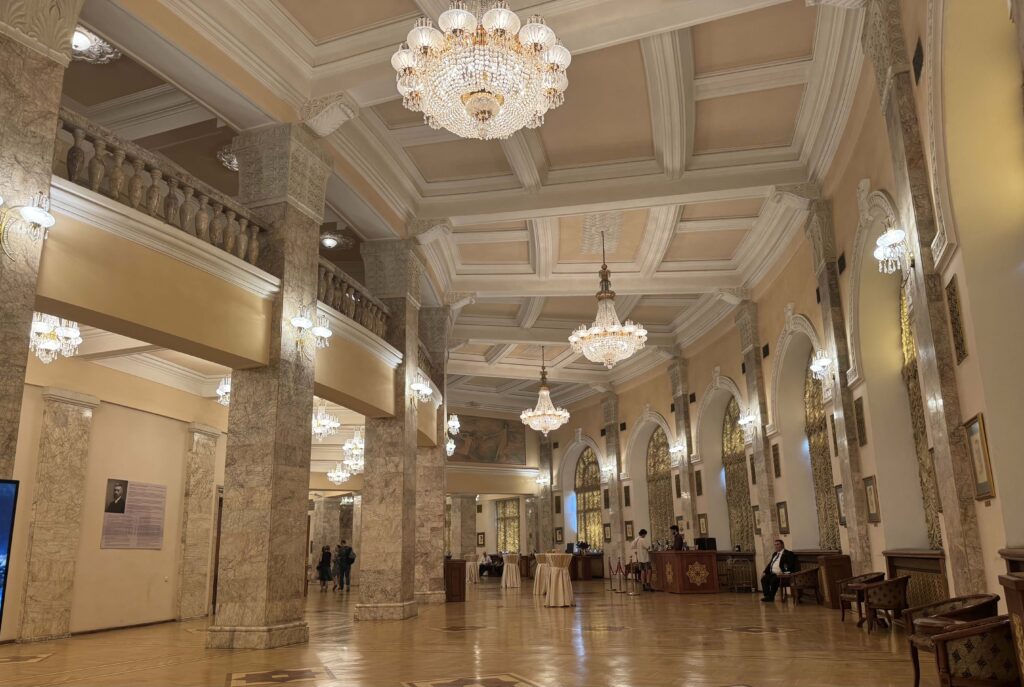
I was anxious to get back to my hotel room, since I had tickets to a 6:00 performance of Othello at the Yerevan Opera House. Built in 1933 by Alexander Tamanyan, the theater’s interior carries the same warm, rosy-pink palette found throughout the capital. Attending was a travel bargain: our excellent seats were only $40, and two glasses of local wine cost just $5.53. If only the projected captions had been translated into English, the night would have been perfect.
Armenia captivated and confounded me in equal measure, and nothing captured that better than the view from the top of the Cascade. Standing on those unrailed granite steps, built by a regime that no longer exists, I watched Mount Ararat fill the horizon — Armenia’s oldest and most sacred symbol, sitting on the other side of a border closed by a historic rival. A nation defines itself by a mountain it can see but can not touch.